
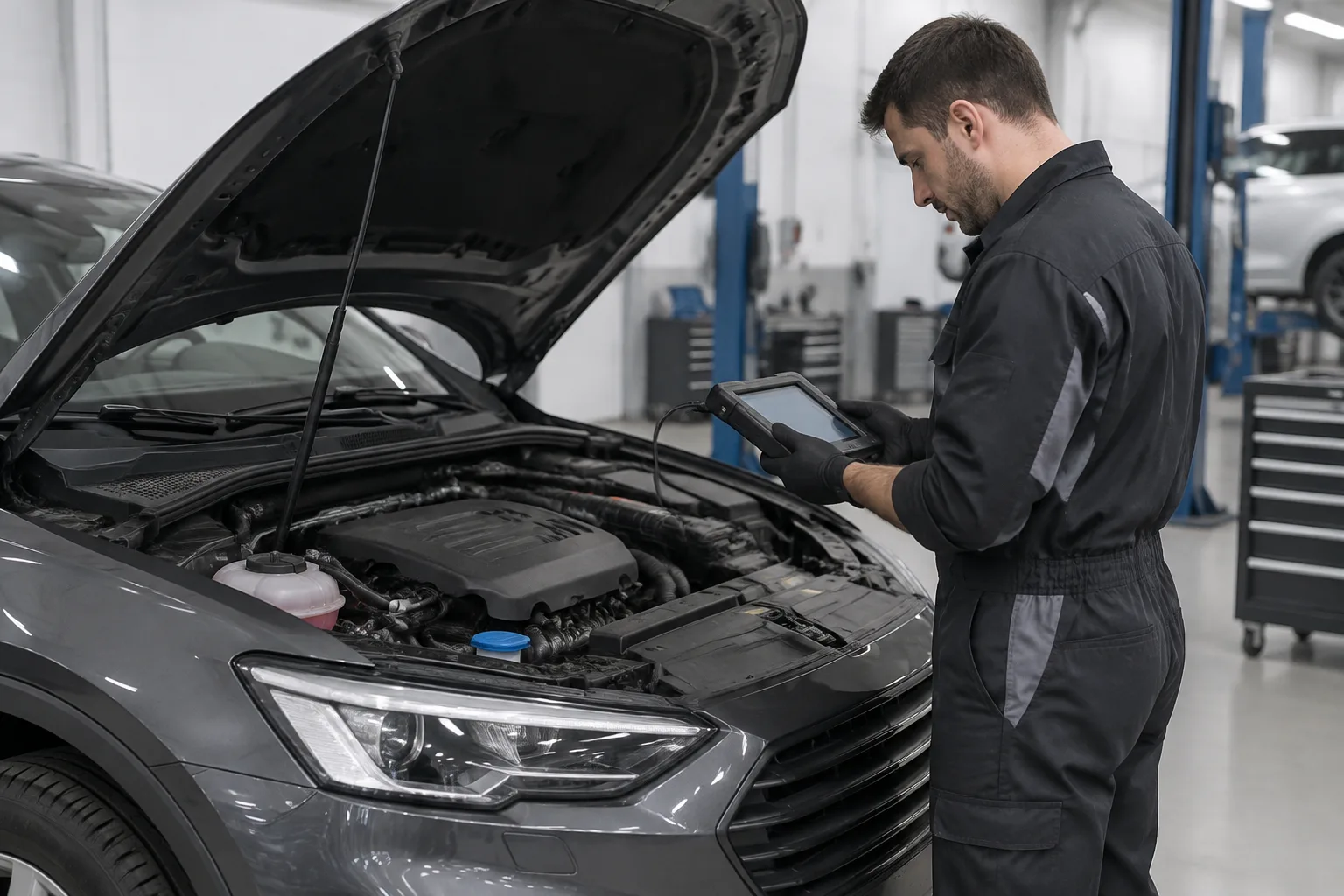
Direct Answer: An AdBlue dashboard warning, countdown, or starting restriction indicates that the vehicle's Selective Catalytic Reduction (SCR) monitoring system has detected an irregularity in its emissions-reduction process. A proper AdBlue ECU solution involves assessing stored fault codes, live sensor data, and physical component operation rather than assuming a single part has failed or performing temporary bypasses.
At Boost Remaps, our Google 5.0* Rated team in London uses a diagnostics-first approach to identify the root cause of emissions faults. Whether you are dealing with a recurring warning light or seeking professional intervention, understanding how these systems operate helps prevent unnecessary part replacements and ensures compliance with UK standards. For more details on our comprehensive vehicle diagnostic services, visit our diagnostic fault finding service page.
Important Regulatory Compliance Notice regarding ECU Solutions:
Modifying, deleting, or disabling original Selective Catalytic Reduction (SCR) or emissions control systems via software/ECU alterations can render a vehicle non-compliant with UK MOT regulations. The DVSA MOT inspection manual states that missing, obviously modified, or deliberately deactivated emissions components will result in an MOT failure. Vehicle owners must ensure that any diagnostic work or software adjustments comply with statutory roadworthiness and environmental standards.
Understanding AdBlue and SCR System Architecture
Modern diesel vehicles utilise SCR systems—such as Bosch's Denoxtronic setup—to inject a urea-based aqueous solution (AdBlue) into the exhaust stream. This chemical reaction converts harmful nitrogen oxides (NOx) into harmless nitrogen and water vapour. To ensure continuous compliance with European emissions regulations like Regulation (EU) 2018/1832, engine control units (ECUs) monitor fluid levels, fluid quality, dosing pressure, injector function, and downstream NOx readings.
When an irregularity occurs, the system logs a Diagnostic Trouble Code (DTC) and initiates a warning sequence. If left unresolved, this can trigger a driver inducement strategy, eventually preventing the engine from restarting.
How Do Technicians Diagnose AdBlue Fault Codes?
A common mistake is treating an ECU fault code as a direct instruction to replace a specific component. For instance, a NOx sensor fault code does not automatically prove the sensor itself is defective; wiring continuity, power supply, software calibration, or upstream dosing efficiency can all influence the reported values.
Professional diagnostics involve a structured, evidence-gathering methodology:
- Full System Scan: Retrieving all active, stored, and pending DTCs across the engine management and SCR modules.
- Live Data and Freeze-Frame Analysis: Examining sensor readings, exhaust temperatures, and injection pressures under operating conditions.
- Electrical and Visual Inspection: Checking wiring harnesses, fuse integrity, heater elements, and fluid lines for crystallisation or damage.
- Manufacturer Procedures: Executing guided test routines and actuator tests as specified by the vehicle manufacturer.
Diagnostic vs. Repair Approaches
When addressing SCR system faults, workshop methodologies vary significantly in scope and compliance. The table below outlines how different approaches compare:
| Approach | Evidence Gathered | Scope | Compliance & Outcome |
|---|---|---|---|
| Code Clearing Only | None or basic scan | Clears DTCs without investigation | Temporary warning removal; fault typically returns immediately. |
| Targeted Component Replacement | Surface-level code reading | Replaces single parts (e.g., sensor or injector) | May resolve physical failures, but risks recurring issues if the root cause is electrical or software-based. |
| Diagnostics-First Repair & Calibration | Full scan, live data, electrical tests | Repairs underlying faults, updates software, and completes adaptations | Restores intended system functionality and ensures long-term reliability and MOT compliance. |
Regarding legal and regulatory considerations, UK government consultations and Department for Transport documentation examine the environmental impact of modifying or disabling in-use emissions systems. Furthermore, DVSA MOT inspection manuals state that original emissions components that are missing, obviously modified, or defective can cause a vehicle to fail its test.
Frequently Asked Questions
What does my AdBlue fault code mean on this exact vehicle?
Fault code definitions vary significantly across makes, models, and ECU software versions. A specific code indicates that a monitored parameter has fallen outside expected thresholds, but accurate interpretation requires cross-referencing manufacturer service data alongside live diagnostic readings.
Does a fault code prove that the NOx sensor or pump has failed?
No. A fault code points to a monitored circuit or system discrepancy, not a guaranteed part failure. Wiring faults, connector corrosion, software communication glitches, or upstream dosing issues can trigger identical error codes.
Can you diagnose the system before recommending parts or software work?
Yes. Boost Remaps operates on a strict diagnostics-first framework. We evaluate live data, perform physical inspections, and review test procedures before proposing any targeted repair, update, or calibration.
Is the vehicle safe and legal to drive while a countdown is showing?
While an active countdown or warning does not immediately disable mechanical steering or braking, driving with a compromised emissions system can lead to unexpected engine non-start restrictions once the countdown expires. Operating with defective emissions equipment may also contravene UK roadworthiness standards.
Can Boost Remaps assess my vehicle in London?
Yes. Our fully equipped workshop and mobile service teams operate across London, providing professional diagnostics, vehicle-specific calibration, and comprehensive emissions system solutions.
Sources and Further Reading
- Driver and Vehicle Standards Agency (DVSA) - MOT Inspection Manual for Class 3, 4, 5 and 7 Vehicles.
- European Parliament and Council - Regulation (EU) 2018/1832 on type-approval of motor vehicles with respect to emissions from light passenger and commercial vehicles.
- Department for Transport (UK) - Vehicle Emissions Compliance and Testing Guidance.