Optimising a modern diesel engine to yield stronger pulling power involves a delicate balance between mechanical tolerances, thermal limits, and fuel injection parameters. For drivers looking to enhance everyday drivability and towing capability, understanding how calibration affects longevity is essential. Achieving a meaningful torque increase without compromising mechanical resilience requires a structured, diagnostics-first approach rather than a blunt-force increase to factory safety parameters.
If you are considering mobile ECU remapping London services provided by Boost Remaps, this guide breaks down how engine management systems handle torque, the importance of pre-tuning diagnostics, and the engineering trade-offs you must weigh to protect your vehicle's long-term health.
Direct Answer: How to Gain Diesel Torque Safely Gaining diesel torque safely through mobile ECU remapping requires a diagnostics-first baseline check, a custom calibration that broadens the usable rev range instead of chasing aggressive peak numbers, and strict adherence to factory thermal and emissions limits. Professional mobile services in London deliver this custom calibration directly to your home or workplace while protecting factory hardware margins. Visitors can also explore our core offerings via the Boost Remaps homepage.How Diesel Calibration Balances Torque and Longevity
Modern diesel powerplants rely on complex Engine Control Units (ECUs) to govern fuel delivery rail pressures, turbocharger boost curves, and injection timing. Peer-reviewed research into diesel engine optimisation highlights that calibration is a multi-variable task where torque, fuel efficiency, emissions output, and mechanical smoothness constantly interact (ScienceDirect engine calibration study).
A professional custom calibration does not simply chase maximum peak figures. Instead, it aims to broaden the torque band—providing a stronger, more accessible pull lower down the rev range—while respecting the thermal and structural limits designed by the manufacturer. Treating reliability as a risk-management goal rather than a guaranteed outcome ensures that fueling strategies and boost thresholds remain within safe operational windows for your specific hardware.
The Diagnostics-First Approach to Mobile ECU Remapping
Before any calibration file is modified or written to a vehicle's ECU, a comprehensive health check is non-negotiable. Introducing increased torque to an engine with underlying mechanical fatigue, failing injectors, a worn clutch, or an inefficient turbocharger can accelerate component failure.
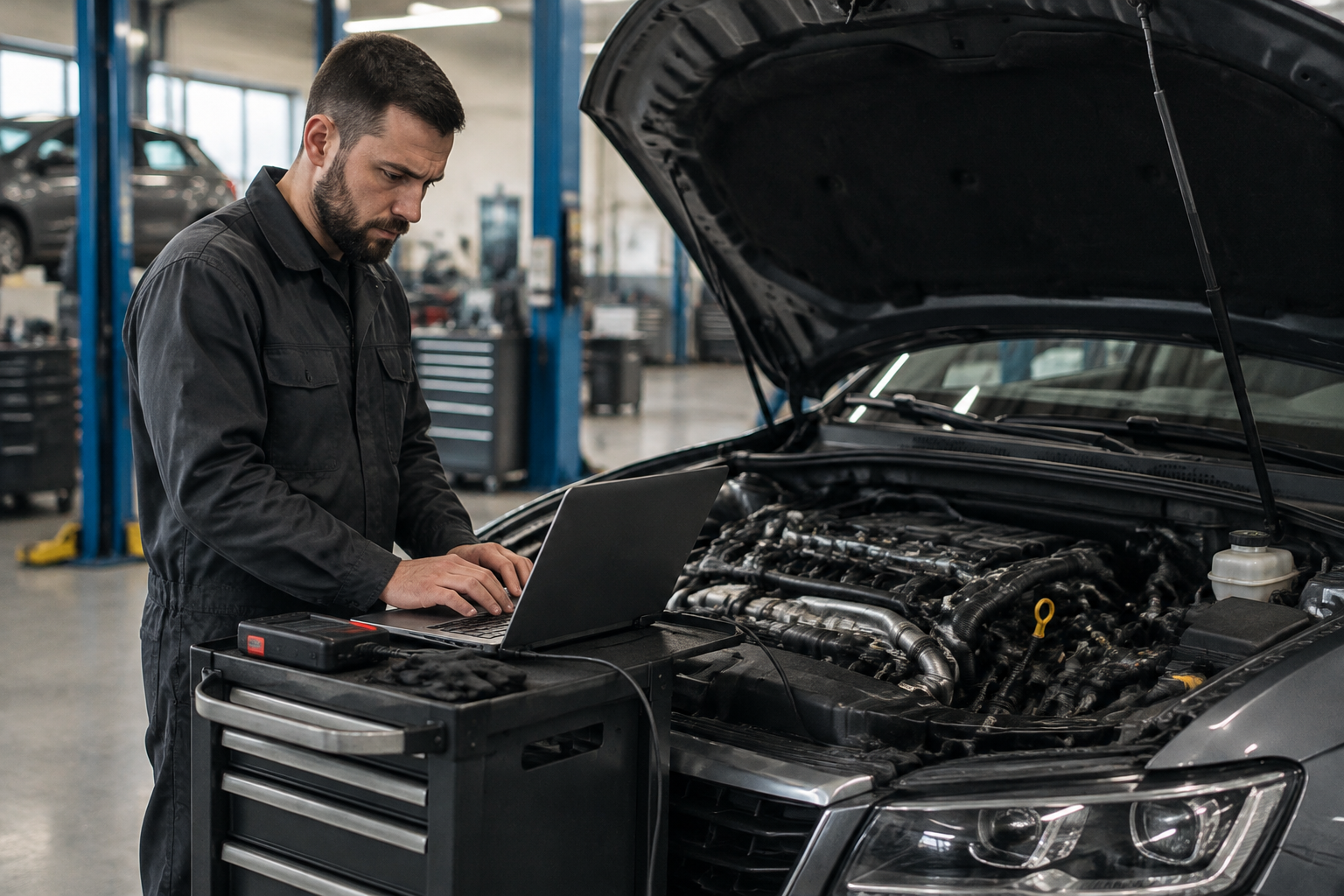
A rigorous tuning process always begins with a full system diagnostic scan to identify hidden fault codes, live data anomalies, or sensor degradation. For motorists utilising mobile services across the capital, a technician should carry out the same rigorous pre-calibration checks on your driveway as they would in a fully equipped workshop. This ensures the engine is performing optimally in standard trim before any tuning parameters are introduced. For a broader overview of how modern electronic adjustments compare to older methods, refer to our guide on ECU remapping vs chip tuning key differences explained, or start with the fundamentals in our beginners guide to ECU remapping.
Emissions Equipment and Regulatory Compliance
When modifying a diesel vehicle for enhanced performance, safeguarding emissions control systems is critical. Modern diesels rely on Diesel Particulate Filters (DPFs), Exhaust Gas Recirculation (EGR) valves, and Selective Catalytic Reduction (SCR/AdBlue) systems to meet strict environmental standards.
Official DVSA MOT inspection guidelines state that missing, obviously modified, or defective manufacturer-fitted emissions equipment—including evidence of DPF tampering—constitutes a major defect resulting in an automatic MOT failure (GOV.UK MOT inspection manual). Furthermore, government guidance on emissions hardware underscores that tampering with or removing standard-fit particulate filters is unlawful for road-going vehicles (GOV.UK DPF guidance note). A professional remapping service must always preserve and respect these factory emissions loops.
Drivetrain Considerations: Clutches, Gearboxes, and Fuel Economy
Increased torque directly impacts the physical components responsible for transferring power to the road. Evaluating your drivetrain before tuning is essential:
- Manual Clutches: Higher torque output can induce slip in older or factory-spec clutches, particularly in lower gears under heavy load.
- Automatic and DSG Gearboxes: Many modern automatic gearboxes have strict torque thresholds programmed into their transmission control units (TCUs). In certain applications, pairing an engine remap with a dedicated gearbox or DSG calibration helps manage clamping pressures and shift points safely.
- Fuel Economy Expectations: While optimising combustion efficiency can alter fuel consumption under specific driving conditions, economy outcomes vary heavily based on driving style, topography, vehicle load, and maintenance history. Avoid blanket promises of dramatic fuel savings.
Tuning Method Comparison for Diesel Engines
To understand where mobile ECU remapping fits into the broader tuning landscape, review the technical comparison table below:
| Tuning Approach | Mechanism | Diagnostics Integration | Safety & Customisation |
|---|---|---|---|
| Mobile ECU Remapping | Custom software written directly to factory ECU | Comprehensive pre-scan & live data monitoring | High; tailored to specific vehicle health & limits |
| In-Line Tuning Boxes | Intercepts sensor signals to trick rail pressure | None; operates blind to underlying faults | Lower; generic resistance manipulation |
| Generic Chip Resoldering | Physical replacement of EEPROM chips | None | Obsolete; rigid and non-adjustable |
Frequently Asked Questions
Can my exact diesel make, model, and ECU be remapped?
Yes, provided the ECU architecture allows for secure read and write procedures using genuine professional tuning tools. A vehicle-specific calibration is written directly to match your engine variant rather than using a generic, one-size-fits-all file.
What torque change is realistic for my vehicle?
Realistic gains depend entirely on your engine displacement, turbocharger efficiency, fuel system capacity, and factory state of tune. Safe calibrations focus on smooth, progressive torque delivery rather than chasing unrealistic peak numbers that stress internal components.
Will a mobile ECU remapping service work at my London location?
A mobile service can be carried out at your home or workplace in London, provided there is safe, adequate space around the vehicle and a stable power supply for diagnostic and programming equipment.
Should I inform my insurance provider or check my warranty?
Yes. Modifying a vehicle's engine management calibration alters its performance characteristics. It is advisable to check your specific insurance policy and warranty terms before undertaking any modifications.