
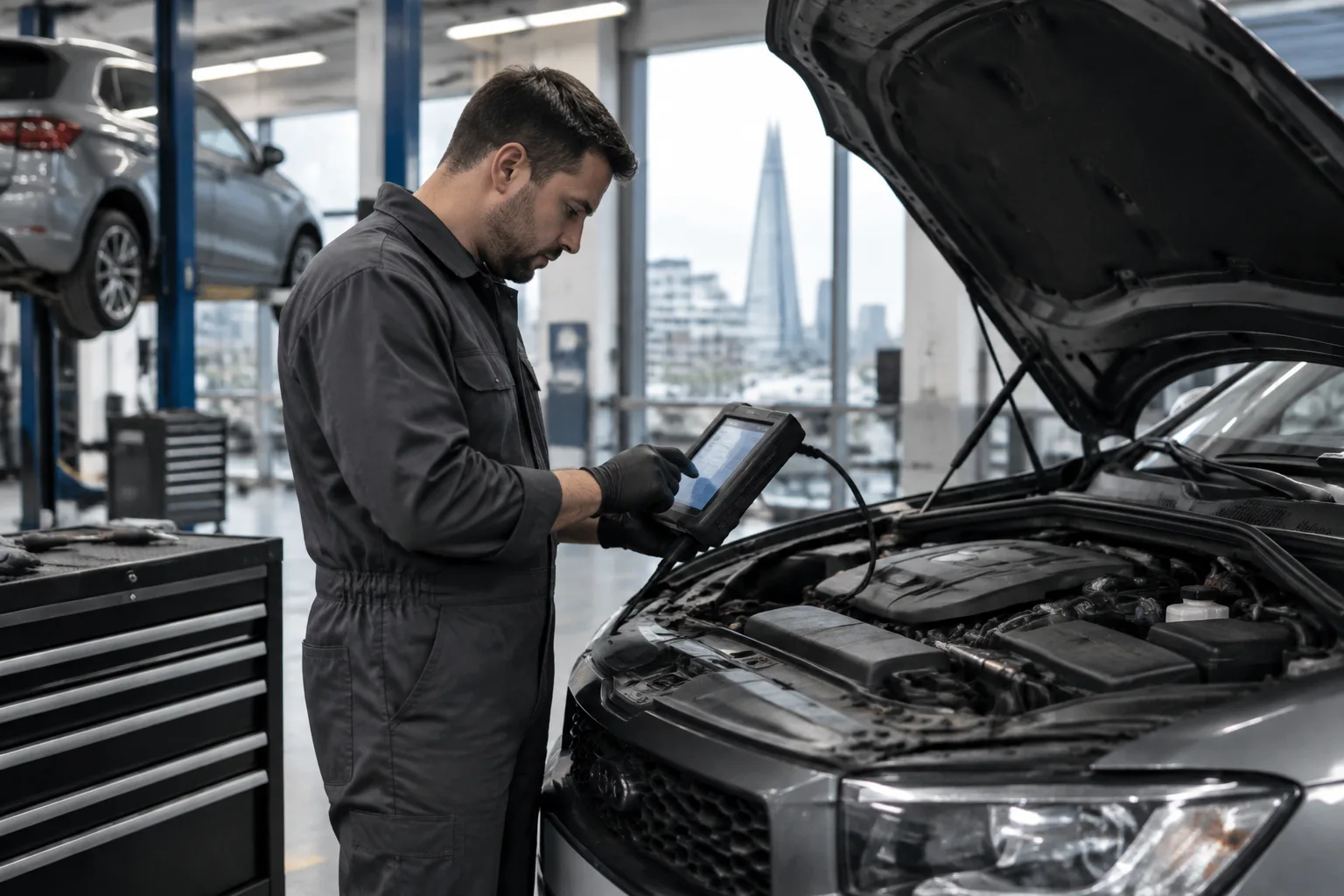
Direct-Shift Gearbox (DSG) systems are engineered for rapid gear changes by utilizing two independent clutches that preselect the next gear. DSG gearbox tuning benefits drivers by replacing conservative factory software with a vehicle-specific calibration that optimizes shift points, clamp pressures, and response times. Unlike an engine ECU remap which alters power delivery, transmission control unit (TCU) tuning modifies how and when those power bands are deployed to the wheels.
At Boost Remaps in London, our diagnostic-first approach ensures that any transmission calibration matches your exact hardware variant—whether you drive a wet-clutch or dry-clutch setup. This guide examines how TCU modifications alter shift strategies, the engineering principles behind dual-clutch control, and what you should consider before modifying your transmission software, while consistently maintaining transparent disclosures regarding hardware limits.
What Does DSG and TCU Tuning Actually Change?
A Transmission Control Unit (TCU) dictates the operational parameters of an automatic or dual-clutch gearbox. While the factory calibration is designed to suit the broadest possible range of driving styles and fuel-economy cycles, a custom remap alters specific software maps within the TCU.
According to technical literature from automotive engineering bodies such as SAE International, shift quality and responsiveness depend heavily on the integrated control of clutch pressure and engine-speed synchronization during gear transitions. Factory software often introduces slight delays or moderate clutch engagement pressures to ensure maximum comfort under standard commuting conditions.
By refining these parameters, a professional TCU calibration can adjust several core operational areas:
- Shift Points: Altering the exact engine revolutions at which upshifts and downshifts occur in D (Drive) and S (Sport) modes.
- Clutch Clamp Pressure: Optimizing clamping forces to manage higher torque loads effectively, particularly when paired with an engine-remapped vehicle.
- Manual Mode Response: Reducing the latency between pressing a steering-wheel paddle and the physical engagement of the requested gear.
- Shift Strategy Behavior: Reducing unnecessary gear hunting in stop-start traffic and holding gears longer under throttle loads.
Comparing Factory Calibration vs. Custom DSG Calibration
To understand the practical impact of transmission modifications, it helps to compare standard factory settings with a professionally calibrated TCU setup:
| Operational Parameter | Factory Standard Calibration | Custom TCU Calibration |
|---|---|---|
| Shift Speed | Optimized for broad comfort and smooth transition jerk limits. | Calibrated for faster, more decisive clutch overlap and engagement. |
| Torque Limitation | Strict factory torque thresholds mapped for standard engine output. | Adjusted limits to safely accommodate upgraded engine performance (hardware dependent). |
| Kickdown Latency | Gradual downshift progression to protect components and maintain fuel economy. | Immediate, direct downshift response upon demanding aggressive throttle inputs. |
| Software Versatility | Generic map built for global markets and varying fuel qualities. | Vehicle-specific calibration tailored to exact gearbox codes and driving styles. |
Evaluating Shift Times and Drivability Trade-Offs
A common point of discussion among enthusiasts is whether DSG tuning makes a vehicle significantly faster. While factory dual-clutch transmissions already change gears in fractions of a second due to their dual-clutch architecture, factory algorithms prioritize suppression of shift jerk and clutch friction work.
It is important to evaluate the trade-offs involved:
- Shift Feel vs. Comfort: A faster or more aggressive shift strategy may introduce a firmer mechanical engagement. Drivers seeking absolute comfort may prefer a balanced calibration, whereas performance drivers often favor a sharper, more direct shift feel.
- Hardware Differentiation: Dry-clutch gearboxes (such as the 7-speed DQ200) and wet-clutch gearboxes (such as the 6-speed DQ250 or 7-speed DQ381) have distinct thermal and torque capacities. A professional tuner must respect these hardware limits rather than applying generic software. Transparent disclosures regarding these hardware limits are maintained across all of our service pages. To explore transmission care and mechanical interventions further, read our guide on DSG remap vs gearbox rebuild, ensuring all internal links resolve correctly post-publication.
- Diagnostics First: A healthy gearbox is a prerequisite for any modification. Worn clutch packs, mechatronic unit faults, or fluid degradation must be identified through comprehensive vehicle diagnostics before software changes are applied.
Frequently Asked Questions
Is DSG tuning different from an engine remap?
Yes. An engine remap alters the ECU to modify fuel delivery, ignition timing, and boost pressure to increase engine performance. DSG or TCU tuning modifies the transmission computer, changing how power is transferred through the clutches, when gears shift, and how the mechatronic unit behaves. They can be performed independently or combined for a synchronized powertrain response.
Will DSG tuning void my vehicle warranty or affect insurance?
Modifying factory software can impact manufacturer warranty claims relating to the powertrain. Furthermore, the Association of British Insurers (ABI) advises motorists to declare any vehicle modifications to their insurance provider, as alterations can influence policy terms and classifications.
Does a DSG tune make the car accelerate faster?
While optimized shift strategies and improved torque handling can enhance overall acceleration consistency—particularly on vehicles with engine performance upgrades—shift times alone do not automatically guarantee faster raw acceleration figures. The exact outcome depends on vehicle weight, drivetrain layout, and hardware capability.
Can any DSG gearbox be tuned?
Most modern electronic DSG and automated dual-clutch transmissions can be recalibrated via diagnostic ports or direct TCU connections. However, compatibility depends entirely on the exact gearbox code, hardware version, and mechatronic software iteration installed in your car.
Sources
- Volkswagen Newsroom, Dual-clutch gearbox (DSG). Available at: https://www.volkswagen-newsroom.com/en/dual-clutch-gearbox-dsg-3651
- ZF Friedrichshafen AG, Dual clutch system – Powerful shifting. Available at: https://www.zf.com/public/org/pkw_a_aktiveanfahrsysteme_2017_72036.pdf
- SAE International, Shift Quality Improvement through Integrated Control of Dual Clutches Pressure and Engine Speed for DCT (2014-01-1748). Available at: https://saemobilus.sae.org/papers/shift-quality-improvement-integrated-control-dual-clutches-pressure-engine-speed-dct-2014-01-1748
- Association of British Insurers (ABI), Guide to Managing the Cost of Your Car Insurance. Available at: https://www.abi.org.uk/globalassets/sitecore/files/documents/publications/public/migrated/motor/abi-guide-to-managing-the-cost-of-your-car-insurance.pdf