When experiencing transmission hesitation, rough gear changes, or warning lights in an automatic Volkswagen Group vehicle, drivers often face a critical crossroads: do they need a software gearbox tune, or is a mechanical transmission overhaul required? Mistaking a failing physical clutch pack for a software anomaly can lead to severe mechanical failure, while unnecessary hardware replacement wastes time and money.
A DSG remap vs gearbox tune comparison fundamentally starts with understanding what each service achieves. A DSG remap alters the Transmission Control Unit (TCU) software parameters—such as shift points, clamp pressures, and torque limits—to optimize drivability and performance. In contrast, a gearbox rebuild is a physical, mechanical repair involving the disassembly, cleaning, and replacement of worn internal components such as clutch packs, synchronizers, bearings, or mechatronics units.
Understanding the Core Distinctions
Volkswagen designs direct-shift gearboxes (DSG) as electronically controlled dual-clutch systems featuring complex hydraulic actuators, sensors, and a dedicated mechatronics module. Software calibration dictates how these electronic signals coordinate with mechanical operations, but software cannot mend physically worn friction material or broken gears.
The table below outlines the core technical differences between software calibration and mechanical overhaul:
| Feature | DSG Remap / Gearbox Tune | Gearbox Rebuild |
|---|---|---|
| Primary Focus | Transmission Control Unit (TCU) software logic | Internal hardware, clutch friction plates, and hydraulics |
| Addresses | Shift sluggishness, torque limits, shift points, throttle response | Mechanical wear, slipping under load, grinding, hard component failure |
| Process | Diagnostic scan followed by custom software rewriting via OBD port | Complete transmission removal, teardown, cleaning, and parts replacement |
| Limitations | Cannot repair damaged clutches, warped flywheels, or electrical shorts | Does not upgrade shift strategies or optimize factory torque handling |
Diagnosing Symptoms: Software Flaw or Mechanical Wear?
Drivers frequently arrive at a workshop complaining of judder, delayed engagement, harsh downshifts, or limp mode. A professional diagnostic approach requires looking beyond the immediate symptom. According to technical documentation from manufacturers like Volkswagen, transmission health relies heavily on scheduled fluid and filter maintenance, proper sensor inputs, and clean hydraulic pressure.
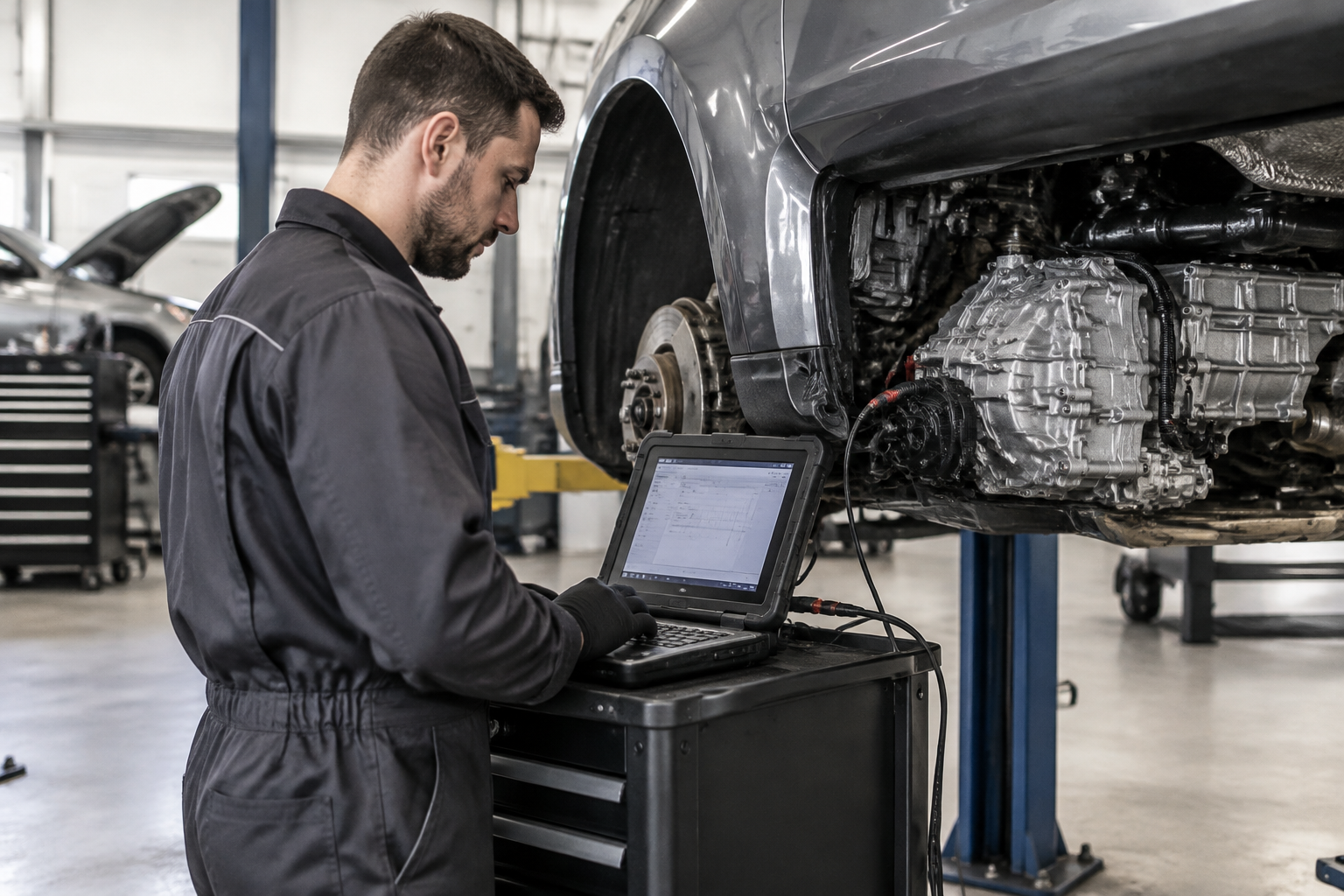
When diagnostic fault codes or live data indicate a mechanical fault, software tuning is neither appropriate nor safe. For instance, if dual clutches are excessively worn or a mechatronics circuit board has suffered physical electrical failure, a remap will not restore structural integrity. Conversely, if a vehicle simply suffers from lazy factory shift maps or hesitation after an engine power upgrade, a custom calibration resolves the software bottleneck without touching the hardware.
What to Check Before Committing to a Service
Before deciding on a software upgrade or a mechanical repair, a structured diagnostic checklist should be performed:
- Comprehensive Fault Scan: Retrieve active and stored Diagnostic Trouble Codes (DTCs) from both the Engine Control Unit (ECU) and TCU.
- Service History Review: Verify when transmission fluid and internal filters were last replaced according to factory schedules.
- Live Data Analysis: Monitor clutch slip values, hydraulic pressures, and temperature sensors during a controlled road test.
- Hardware Inspection: Check for fluid leaks around the transmission housing, mechatronics plug seals, and dual-mass flywheel condition.
Specialized diagnostic platforms and adaptation procedures—such as those detailed in industry references like Ross-Tech—highlight that proper basic settings and clutch adaptation prerequisites must be strictly met depending on the exact transmission variant (such as wet or dry clutch DSG designs).
Important Considerations for Wet vs. Dry Clutch Systems
When evaluating torque capacities and the limits of software calibration, it is vital to distinguish between dry clutch (e.g., DQ200) and wet clutch (e.g., DQ250, DQ381, DQ500) DSG variants. Dry clutch gearboxes operate with uncooled friction plates enclosed in a dry bell housing and have strict factory torque thresholds. Exceeding these limits via a remap without mechanical reinforcement can rapidly burn out the clutch pack. Wet clutch variants run submerged in oil, allowing them to handle significantly higher thermal and torque loads, making them more receptive to aggressive TCU calibration provided the hydraulic Mechatronics and clutch friction material remain in healthy, uncompromised condition.
Frequently Asked Questions
Can a DSG remap fix slipping clutches or severe judder?
No. While a TCU tune can adjust clutch clamp pressures within safe operational limits, it cannot reverse physical wear on clutch friction discs or warped flywheels. If a transmission is slipping due to mechanical wear, a hardware repair or replacement is mandatory.
Is a diagnostics-first approach necessary before tuning a gearbox?
Yes. Reputable technicians always perform a thorough diagnostic scan and mechanical check before applying any software modification. Tuning a transmission with existing hidden faults or failing mechatronics units can exacerbate issues and lead to premature failure.
Will a gearbox tune void my manufacturer warranty or affect insurance?
Modifications to vehicle software can impact manufacturer warranties regarding powertrain components. Additionally, insurance providers require disclosure of modifications. The Association of British Insurers (ABI) notes that any change from factory specification should be declared to your insurer to ensure policy validity.
How does an engine remap interact with a DSG transmission?
Increasing engine power and torque via an ECU remap places a higher load on the factory transmission limits. A matched DSG remap is often used to raise torque limiters and optimize clamp pressure to match the engine's new output safely, provided the physical gearbox components are in healthy condition.
For vehicle-specific assessments, professional diagnostics, and custom calibration tailored to your exact transmission code, consult with skilled technicians at Boost Remaps in London to determine the correct path forward.
Sources and References
- Volkswagen UK: Technology and Transmission FAQs (Volkswagen UK Technology)
- Volkswagen Newsroom: Technical Glossary (Volkswagen Newsroom)
- Ross-Tech Wiki: Direct Shift Gearbox Procedures (Ross-Tech 0BH/0BT)
- Association of British Insurers (ABI): Motor Insurance Guidance (ABI Guidelines)